Friday, May 24, 2013
Index
Opening Statement
Essay 1: What I Know - Introduction to Zombie-Ology
Homework: Response to Student Critique
Homework: Response to David Cole's "Getting Nearer and Nearer"
Homework: Toulmin Analysis - "State of the Art"
Essay 2:
- Critique of Article #1
- Critique of Article #2
- Critique of Article #3
- Comparison of Sources
- Essay Outline
- Evaluation of Peer Draft
- Response to Peer Review
- Critique of Arguments - Cases for the Educational Gap Year
Midterm: Reflection
Essay 3:
- Critique of a Column
- Inquiry Between Columns
- Exploratory Draft
- Review Draft
- Proofreading Draft
- Inquiry - The Legacy of the Occupy Movement
Essay 4:
- Exploratory Draft
- Blocking Plan
- Self-Evaluation of Draft
- Review Draft
- Book Club - Reality is Broken by Jane McGonigal
Closing Statement
What I Know: Introduction to Zombie-Ology - A Draft Past the Final

An Introduction to Zombie-Ology
An Introduction to Zombie-Ology
(A Draft Past the Final)
One evening, my family watched the film ParaNorman, of all things.
All were impressed. We switched off our home 3D glasses. They expressed their
great satisfaction with the quality of the animation. The first sentence I
spoke, meanwhile, was: “I liked the twist that the town wasn’t cursed with a
zombie plague – instead, just a few people were cursed with being zombies.”
I didn’t receive a direct verbal response. I did, however, feel
the implied “That’s nice, Dillon. You have fun with your zombies.”
Though I couldn't call myself a real connoisseur, exactly, I’ve
had a little of a special curiosity toward monster and horror media ever since
my mother would let me watch her play Resident Evil on the PlayStation - from
the age of four consistently onward until I could trust myself to play any game
on my own without succumbing to a near-visceral fear of losing! (As a disclaimer, I would
like to insist “I turned out all right.”) It’s gotten me to read that “zombie”
is Swahili in origin, to know that I have much more of an interest in zombies
than in vampires, and to catch that certain types of monsters appear in certain
types of plots. You hardly see zombies treated as characters, rather than
hazards on legs – in a film, a little girl convicted of witchcraft would
normally schedule a raising-of-the-dead to plague the village that persecuted
her, wouldn’t she? Of course to see her cursing the jury to rise as zombies and
find themselves hunted by the village as monsters is switch!
Mine is a household with multiple computers, Netflix, and every
current video game console. My parents, so it seems, watch a new movie before
bed at least twice a week, and follow at least one “streamable” television
series at a time. However, though of course they happen by a new scary movie
that they go on to recommend to me every now and then, the sole bit of monster
fare they seem to be “fans, exactly” of would be The Walking Dead
show. Talk to them about horror – which pieces are stupid, which are actually
scary, and so on – but people get used to having little to say about zombies.
They’re the simplest of simple monsters: wandering, mindless eaters – it’s seen
so all the time.
It’s a shame for monsters to ever be approached without
imagination or deeper thought. Various types of living dead may have grown from
a simple origin – “ghost stories” and old wives’ tales sparked by a basic deep
discomfort regarding dead things – into a number of different stories and
types. However, those types are not the story formulas they’ve come to be
attached to – they’re their own concepts, each turning the idea of a dead thing
getting up and walking into a somewhat unique sort of monster. Different types
are naturally in-place than the others in the types of stories that inspired
the direction of their mythology’s growth. That’s not because monsters, zombies
included, are their pigeonholes but because of all that there is to them
inherently.


A model of traditional Norse funeral rites. Image from lore-and-saga.co.uk.
"He looks very restful. Does he not?"
The basic idea of THE LIVING DEAD
is, again, a simple one. Fear of losing life has existed as long as animals’
consciousness, and sometimes, when a person is afraid of something, they kiss
up to it – revere it, give it the utmost respect, pray to god they don’t make
it angry. That and the fact that what happens after death is one of those
unanswerable questions – nobody’s come back to tell us, after all! And who’s to
say that’s because they can’t? – have had people to the beginning of culture
devising rule after just-in-case rule governing disposal of corpses. If the
Egyptian MUMMY
is going to stay in his pyramid as long as the embalming process keeps him
intact, perhaps he’ll want a game of solitaire to get him through the
centuries; if the Norse DRAUGR takes
offense to the fact that you left a bit out of his last rites, it’s a good
thing we carried him feet first through the doorway so he can’t see the route
we took from home and follow us back; if the Chinese JIANGSHI manages
to find us anyway, for goodness’s sake, he’s dead and stiff, and we have steps
leading up to the threshold. (The jiangshi is an interesting case – it’s
commonly referred to as the “Chinese vampire”, but in legend, it rises from the
grave when the primal half of the Yin Yang balance comprising a person’s soul
stays in the body longer than the conscious half, moves stiffly, and doesn’t
feed on blood at all but chi life essence
– debate if you like on whether blood or brains are more essential to life).
Those three are easily categorized now according to the current
concept of a “ZOMBIE”
- a slow-moving and normally mindless and empty-headed monster, taking after
the word’s mythological origin as a body made mobile to serve as a sorcerer’s
slave or “puppet.”

Anthony, the Cursed Messenger. Eternal Darkness: Sanity's Requiem.
The MAGICAL ZOMBIE –
one of the dead raised by a curse or spell – is obviously the traditional kind,
if not so often seen in media any longer.
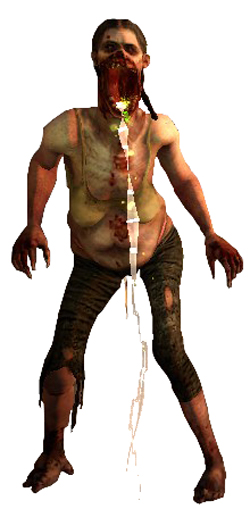
"The Spitter", Infected Bulimic Woman. Left 4 Dead. Image from the Left 4 Dead Wiki.
The INFECTED ZOMBIE,
created by a parasite or rabies-like virus that apparently keeps the body
running long after the brain shuts off, is the more recent, popular kind. Their
sci-fi origin, after all, lends itself to easily-sold, universally-hitting
visceral gore-horror: grotesque mutations and over-the-top symptoms of illness.
Not only that, but while magic now is typically thought passé and silly, you’ll
find people who think that the idea of infection-induced zombification sounds
unnervingly plausible – I encourage you to look up parasites that attack the
brains of ants and slugs. These zombies are also simply termed “INFECTED”, removal of the implications
of the word “zombies” in the terminology providing a fairer term for a subtype
occasionally nicknamed “RAGE ZOMBIES”,
which is the type seen in such films as 28 Days Later – much more alive and spry
than the archetypal shamblers, but every bit as feral, pain-blind, and utterly
incapable of reason. If there’s another draw to use of “infected”, it’s that
their plague-bearing lends to building hordes. For shoot-‘em-up gamers looking
less for a tense horror story and more for new gratifying heads to pop, the
excuse of a zombie plague will give them waves of dozens after dozens of
monsters, however humanlike, to go at without remorse. In the movies,
meanwhile, “In a
World Where” humans risk being outnumbered by the dead, the seed exists for
a distinct plot.
ZOMBIE PLOTS, like zombies, come most clear-cut in two
distinct flavors. Both play on the idea that zombies become exponentially
scarier with numbers – how can you defend yourself against a whole troop of
things capable of thinking about literally nothing but
trying to eat you alive?

The rather displaced Judge and Jury Zombies. Paranorman. Image from IGN.com.

ZOMBIE CURSES and MASS RESURRECTIONS catalyze
old-fashioned dead-rising-from-the-grave stories. They’re not so uncommon in
PG-and-down “scary” media likely because nobody’s life needs to be rushed to an
end, implicitly or explicitly, for zombies to appear. In Tim Burton’s (albeit
not “horror”) Corpse
Bride, most of the people in the Land of the Dead were old – and their
grandkids, widows, and so forth weren’t too displeased to see them once they
realized they only came back to the living world to attend a wedding.

Lee and Glenn going about business. The Walking Dead: The Game. Image from nonspecificaction.com.
Apocalypse media in the meantime has become prevalent enough for its own subgenre within the past
over-a-decade, and, like the rest, the ZOMBIE APOCALYPSE sub-subgenre
is often used by its writers to – often not gently – display their idea of
humanity without organized society. Curiously enough, the zombies themselves
tend to be used to critique that society – filmmaker George Romero is known for
using his zombies as a metaphor for consumerism. There are a few more positive
spins in lighthearted zombie media, which does in fact exist: the silly film Zombieland and
video game Left 4
Dead each focus on a small team of living who stay living by
bonding in crisis. The
Walking Dead, across a graphic novel series, TV show, and video game, seems
to mix it up – its characters survive their best in hard times by cooperating
and aiding each other; it doesn’t mean they’ll do it.

Rick and Glenn, "mingling." The Walking Dead. Image from IGN.com.
Holding to these plots as
those “for” zombies, maintaining formula in their use, and any decision that
improving upon formula necessitates no more or less than more and different
zombies (the latter of which may result in a plot featuring “zombies” that are
not zombies at all – “rage zombies” technically are but pure violently mad living
humans) may be to blame for their dulled relevance and intrigue in popular culture. Naturally,
the more zombies are there, the more ease with which they can get you – or rather,
that you can be “gotten.” There’s little reason to fear TURNING, the ease of which is obligatory to virus zombies, as once
you’re caught and bitten you’ll likely be ripped apart by the ones scuffling
for your meat with the one that did it long before it can begin to fall on you
with a disturbing thump that you’re doomed to turn into a monster; even your
friends and fellow survivors are likely to watch briefly in horror before you
become just another one to the tally. When a fear becomes a part of characters’
everyday life, it ceases to be a fear relevant to the plot more than the fear
of crashing one’s car in reality. Too-pervasive and too-explainable zombies
become little more than another physical threat as is nuclear toxicity or
bandits of zombie-less apocalypse scenarios. Sense of challenge eventually
falls from anything unique to the threat of zombies to survival – most popularly,
in current culture, within cynical terms of social structure and psychology. Zombies’
origin is most compatible with horror; their current use is within thriller, as
much that is labeled “horror” in recent days comes closest to, about what is
happening, and less what is there, or what can happen.
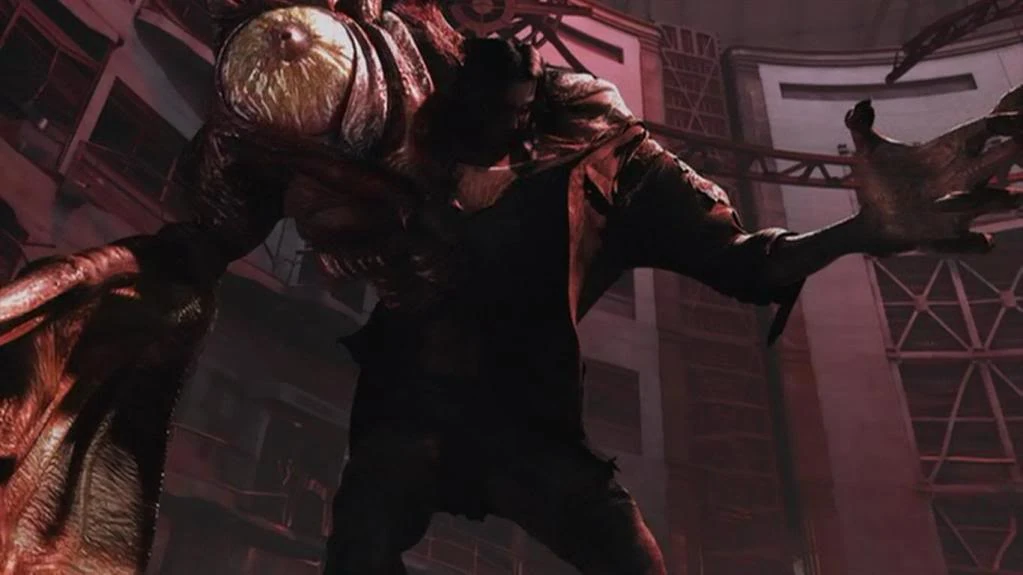
Former Mad Scientist William Birkin. Resident Evil: The Darkside Chronicles. Image from monster.wikia.com.
Conceptual imagination, paranoid
and superstitious or deliberate and daydreaming, is horror’s real spine. All
monsters are products of a degree of imagination, including every form
in which the living dead appear, and a zombie that simply sits about to be a
zombie is indeed rather a heap-of-rot waste. Zombies are nearly always made
from characters or what theoretically would have once been characters, for
example; where does the real fear of being caught by one lie – in the thought
of devouring by something wrong and yet so surely, surely human, or in the
thought of turning and watching everything that you’ve ever considered you
deteriorate in an ultimate of going insane? What are all the implications of the existence of whatever made them?
Monsters eat what they eat within
their stories; on the storyteller’s level, to deprive them of imagination is
to rip out their teeth. They are fully as frightening, creepy as they are not forbidden from being. In all cases, their
minds are their implementers’ – and, therefore, zombies are not mindless at
all.
English 100 - Closing Statement
Over the process of compiling and jotting down reflections on the contents of this semester's portfolio, I believe I've been reminded of the importance of performing one's favorite tasks according to nature - if it hurts (and if it stresses, it hurts), then you are doing it wrong. If you are not feeling a project, you are taking the wrong approach. If you feel compelled to actively scramble for top-quality, recalibrate in your plans before you fluster yourself and falter; if you feel no need to put your mind into a task, then your mind indeed isn't in it.
Nicely reflective of Jane McGonigal's writing this is - "work is more fun than fun"! A task that you're doing and are capable of doing well does not discourage but nevertheless demands your skill and your will. It ought to challenge, wring your mind just well enough to get the sweeter juice free, and it's best a consensual challenge although the nature of the prompts we were given more often than not accounted for the consensual aspect. The two essays I was least proud of were one that I overdid just enough to make a mess of and not enough to make a coherent mess of, and one that I needed to remind myself I could make into more than a rehash of another project - yet felt compelled to deviate from the prompt to do so. Alternatively, I coasted along and merrily connected dots in the formulation of Essay 2, and a silly essay about zombies, under different limitations, I could have chased to shape up into a pride and joy. And I do suppose writing things has always been enough of a "game" for me for it to really apply.
The final lesson, then, is a reminder that the key in an enjoyable task that you're of any supposed skill in is nature and then refinement. If it feels good, then continue to do it, and then tidy up afterward.
English 100 - Opening Statement
Interesting it was to me to have entered a class with a focus on the artistic qualities of nonfiction writing. Nearly all that I'd done in the past for pleasure was informal brainstorming and thought-sorting. Throughout middle and high school, strictly-formatted essays are inevitable and frequent. It is barely creative writing.
All of that said, I had no particular expectations on enrolling. I expected that at this systematically more advanced level of English writing, either the class would demand even greater rigor or students would be trusted to remove their braces. From Essay 1 on, it proved to be the latter case - write what you know, use a natural voice - a silly one if you would like, do well to twist inside and crack the shell of old intro-body-body-body-conclusion essay format. Onward and forward, the subject of the class is largely how to write meaningfully, and not merely on and according to demands. Monitor conversation. Work your own thoughts in. Analyze what you've heard and gathered. Do it all with detail - mind your logic and its qualifiers and exceptions, as Stephen Toulmin suggests.
Properly done academic and other such fact-of-thought writing is as gameful and personal as imaginative speculative writing - and nice it's been to be allowed to loosen the strings and given instructions on how one might move.
Preparation for Essay 2 - Evaluation of a Peer Critique
Dillon Waugh
Hayes
English 100 – 9:10
2/21/13
Word Count: 609
Peer Outline
“Tracing” and Evaluation
|
Paragraph No.
|
Section
|
Content Notes
|
|
1
|
Intro - Overview
|
Introduces topic to which the three
authors are responding, and their claims.
|
|
2
|
Intro - Thesis
|
Explains choice of preference for
Wethal’s case.
|
|
3
|
Body
|
Centers on weakness of Weiss’s
evidence.
|
|
4
|
Body
|
Explains that Linz detracts from his
own argument with his evidence’s presentation.
|
|
5
|
Body
|
Contrasts Wethal’s evidence to Weiss’s
and Linz’s – it is both clearly relevant and needn’t have its credibility
overemphasized.
|
|
6
|
Body
|
Returns to Linz’s case, in which he
shares data for but fails to refute the opposite side.
|
|
7
|
Body
|
Points to Wethal’s successful refutation.
|
|
8
|
Body
|
Notes that instead of nodding to any
counterargument or data to contradict him, Weiss twists data in favor of his
argument – he appears to view everything through a heavily tinted lens.
|
|
9
|
Conclusion
|
Wethal’s case is strong where the
others’ are weak.
|
COMMENTS
Global:
-
Your critique is strong in its reasoning as it’s
presented – of course, I’ve not read the three columns myself, but I suppose
that aids objectivity! You likewise come off as objective by your evaluating
the three columns with entirely different stances on the exact same merits.
-
Your writing voice in particular, I think, is
solid, and it’ll be more clearly so with a bit of cleaning up on the “small
picture” level.
Organizational:
-
Your flow suffers from the final paragraph
returning to Weiss’s weaknesses – especially as you mention the same criterion
that you use to compare Linz and Wethal’s writings immediately before. I would
move that second-to-the-last paragraph in front of the one that returns to Linz
to mirror the three paragraphs that come before - three paragraphs contrasting
Weiss, Linz, and Wethal’s evidence and three paragraphs contrasting Weiss,
Linz, and Wethal’s use of refutation. After doing so, I would tweak the
beginnings of the Weiss and Linz refutation paragraphs so they don’t come off
as redundant when put closer together.
-
Your two introductory paragraphs could be
divided a bit differently – instead of ending the first paragraph with your
evaluation of the three columnists’ arguments and elaborating on it in the
next, that could all go together in the second paragraph, after your short
summary of their thoughts on pornography.
Paragraph:
-
Although it would make sense to present perhaps
one of your direct quotes from the columns the way that you do, I would think
of how to shorten and integrate. For example, in the third paragraph, “…try to
make sense of it: Weiss informs us that ‘Two thirds…’”
-
You had mentioned that you tend to have trouble
with transitions that you’re really satisfied with – though I do think that
your between-paragraph transitions could be smoother, it doesn’t show within
paragraphs at all. Your train of thought runs more than smoothly enough.
Sentence Craft:
-
Apart from a few slip-ups in tense and
punctuation (a couple spots where semicolons and commas are either not present
but might help the paper read more naturally or seem superfluous, and another
place where you can use colons), I think everything does its work at this
scale, aside from one moment in the seventh paragraph – did you mean to say
that Wethal points out that for those who regularly view illegal porn, crime is a part of everyday life?
Word Choice:
-
There are a few redundancies and spots where
your wording could be strengthened, particularly when it comes to verbs, but
apart from that, again, I wouldn’t say that anything’s urgently wrong!
-
Small two-letter-word mistake I’m certain you’ll
catch but that I’ll include in case – in the third paragraph, you’d typed “the
arguments on which the claim relies on.”
Thursday, May 23, 2013
Essay 4 - Book Club - Reality is Broken: Why Video Games Make Us Better And How They Can Change the World by Jane McGonigal
Dillon Waugh
Hayes
English 100 – 9:10
5/5/2013
Word Count: 1,771
Book Club Response – Review Draft
Entertainment media is a silly thing, or so it’s considered – a frivolity, a way to shift one’s mood or blow off a bit of steam. Nonetheless, real quality entertainment is inherently elegantly and complexly produced. To entertain, after all, one must understand the directions in which human thought moves. To entertain, an entertainer needs to give their audience what they want and strike the right buttons. A game developer like Jane McGonigal would know, especially as an interactive medium such as video gaming is obliged to draw a particular investment and engagement from players. In her book Reality is Broken: Why Games Make Us Better and How They Can Change the World, she explains simplistically what it is that a gamer seeks from a game – and steps forward to pose ways in which the insight into human happiness psychology provided by observing games can enhance real life.
McGonigal’s divides her argument into three parts, or rather layers – the first of which centers on the profound appeal of video games to their players, the second and third sections proceeding through describing and proffering examples of the application of knowledge of what makes a game fun to enhancing and developing real-life tasks. To read through all three sections with the Toulmin Model of Argumentation in mind keeps their unity undeniable; the first introduces the author’s claim with the potential rebuttal or naysayer in mind, the proverbial “They” in the title of Gerald Graff and Cathy Birkenstein’s They Say/I Say, the acknowledgement of whom in defining an argument’s context and significance the two claim is essential in academic study and writing. As the author describes, video games are not appealing as an excuse to detach from life and laze as is a non-gamer misconception – in fact, they are appealing because of the fantastic sense of productivity that, in by her reasoning, they instill through inclusion and particulars of what McGonigal presents as “the four defining traits of a game”: firstly, all video games have goals to which progress is measureable and never impossible and that provide a sense of meaning; for a task to be a game, it must present challenges and rules (often arbitrary – McGonigal points out that Scrabble would be less of a game if participants couldn’t only use seven tiles or weren’t required to build off of words already on the board); a feedback system acknowledges success and progress, ideally encouraging the player to apply themselves to a game’s tasks and explorable worlds and old scores to beat keep them further and fantastically busy; finally, games remain enjoyable by the voluntary nature of their participation – an activity that a person partakes in due to obligation and not choice is oppressive, not recreational. A good video game (or any other sort of game, for that matter) may, therefore, be considered “work” – she steps back to neatly display her own “warrant”, all-important logic behind the trail of thought that proves the sense of its use: that a human being craves work over so-called relaxation, something to challenge and demand application of skill and testing of limits, as long as it is “theirs.”
This insight into the psychology of fun is, at many points, bemusing and liable to set one’s figurative lightbulbs sparking. It’s true that a game that allows its player to do absolutely anything that they want is hardly a game at all, and McGonigal quotes psychologist Brian Sutton-Smith in that “The opposite of play isn’t work – it’s depression” – both playing a game and performing intense work stoke the spirit and feeling of productivity. She provides the backing that Toulmin’s model includes as essential for proving that a warrant’s logic is indeed logical, pointing to corroboration with psychologists, studies indicating the chemical rewards of blissful success and other situations that induce them – for example, she early introduces the concept of “fiero”, an Italian word for “pride” used among game designers to name the feeling of triumph a well-designed task should provide and which, “according to researchers at the Center for Interdisciplinary Brain Sciences Research … is the emotion that first created the desire to
leave the cave and conquer the world” [McGonigal, 33]. She contrasts true “fun” with relaxation. However, fairly enough, McGonigal’s theories on what draws a human into wanting work are supported by the arguably classic theories of others. Parallels stand between her defining features of games and workplace theories Maslow’s Hierarchy of Needs and Frederick Herzberg’s motivational vs. hygiene theory: the first suggests that a person whose survival demands are satisfied will seek out action that brings them friendship and belonging, self-affirmation, and growth; video games provide a platform for bonding, including with those a player may never have met on their own in person, and the quests to mark off and old scores to beat that account for feedback systems praises one’s performance while encouraging self-one-upping, so to speak. The second states that a job must meet certain requirements to content a worker in such areas as pay rate and workplace safety, but that job satisfaction comes from variety, challenge, independence, and clarity of a job’s efficacy and purpose; McGonigal claims that video games provide a satisfaction that general real life does not, and that it does so through presenting surmountable obstacles for a challenge, independence afforded through choice in participation and approach, and feedback through score, milestones, or environment to show players their performance’s quality and impact. The bottom line is that humans are happiest and most engaged when performing work that they want – think of middle-schoolers wheezing laps around a football field before picturing teams of volunteers training enthusiastically for a marathon. Voluntary exertion, whether of mind or body, is fun, and fun is voluntary exertion.
The second and third sections of the book, meanwhile, proceed through describing and proffering examples of the application of knowledge of what makes a game fun to enhancing and developing real-life tasks, from helping flight-shy passengers stomach plane rides to “crowdsourcing” anti-cancer research with protein-folding puzzle games. It is here that the sixth component of Stephen Toulmin’s conception of a complete argument, the qualifier that specifies necessities for and limitations of an argument’s applicability, is found; Timothy Crusius and Carolyn Channell’s Aims of Argument offers, as examples of Toulmin-style qualifiers, “on the whole,” and “usually,” while McGonigal’s are “provided that” and “bearing in mind” – what game elements work, and combined with what, for what reaction? Any insight, needless to say, has its practical uses, especially where the feeling of human fulfillment is concerned – although the ARGs (“Alternate Reality Games” – games played on the set of the real world) that she presents, while intriguing in their right, seem like slow steps into turning reality into a fantastic and fulfilling game. Would a person think to sign up for the adventures-in-chores game Chore Wars if they didn’t derive some enjoyment from – or at least maintain a commitment to – their chores even without having their motions described in fantasy euphemisms and receiving abstract points for their completion? Meanwhile, the “productive games” such as Foldit given are repetitive and formulaic with little incentive or reward for commitment, leaving wonder that whether their drawing in players proves that playing games for the greater good is as fun as playing ordinary ones or that people will happily perform easily-accessible volunteer work. On the other hand, a museum found a level of success in creating and presenting a plotted ARG to members that prompted them to design works of art and museum exhibits along the path to solving a mystery story, and frivolous ARGs such as the infamous Ben Drowned, beginning as a short story of a man haunted by a ghost that had been possessing an Nintendo 64 cartridge and evolving into a game inviting the story’s fans to help him banish the ghost by blending the game’s rules with reality’s, also held attention by sending players on or at least tasking them to assist on an adventure. This would, however, tie back to McGonigal’s description of the importance of the concept of “epicness” to gamer culture: the greater the scale, the greater the meaning; beating one’s old score in a game of Tetris in the car is triumphant, while slaying beast after rampaging beast culminating in banishing their dreaded god in an RPG is much more so. Although McGonigal does not herself include this among her qualifiers, tucked all around media are tiny games fitted for bits and pieces of real life – it would be quite a thing to imagine it all woven together into one big, truly “epic” game (or two, or three) running through reality to chase.
While McGonigal’s examples may be proof of potential rather than fact, her arguments are clear, her language is easily digestible, and her quotations by psychologists and other such figures draw their fingers over pressure points and drive their keys home. She makes her case in a way that isn’t difficult to grasp by any means – except, perhaps, to those unfamiliar with game lingo and titles. World of Warcraft certainly can’t be painted well in broad strokes, and her use of the term “achievement” is nonsensical out of terms of gaming (it refers to a merit badge of sorts awarded for completing certain specific tasks in a game, for those out of the know). In addition, on a sheerly technical level, her section formatting is inconsistent – yet her argument continues to read smoothly.
Overall, Reality is Broken comes highly recommended as a sufficiently thought-provoking book, and is well-structured and intelligently-argumentative enough for value as academic reading – but not for just any classroom’s setting. Once again, McGonigal’s book is an easy read, and ease of reading may be best compensated for with ease of discussion; as its subject in popular culture grows increasingly close to home for most, one of its greatest strengths in an academic contest is the ease with which it is respondable. McGonigall’s “I Say” becomes will easily become a group of gamers’ “They Say” in a small-scale step in furthering the ongoing proverbial discussion. Meanwhile, a group consisting partially of gamers may likewise generate respectable amounts of discussion after explanations of terms; strict non-gamers may read dispassionately and with too little context to make connections and speak freely, and as McGonigal herself reminds, what good comes out of involuntary work irrelevant to one’s interests? Accordingly, however, even those less familiar with gaming, however, may get a bit out of indulging any curiosity by making it into a subject of pleasure reading, as might anyone else, for a take on the psychology of happiness and invitation to introspection on why we enjoy what we enjoy.
Works Cited
McGonigal, Jane. Reality is Broken: Why Games Make Us Better and How They Can Change the World. New York: Penguin Books. 2011. Print.
Crusius, Timothy W. and Carolyn E. Channell. The Aims of Argument: A Brief Guide. 7th Edition. New York: McGraw-Hill. 2011. Print.
Graff, Gerald and Cathy Birkenstein. They Say/I Say: The Moves That Matter in Academic Writing. 2nd Edition. New York: W. W. Norton & Company, Inc. 2012. Preparation for Essay 4 - Book Club - Review Draft
Dillon Waugh
Hayes
English 100 – 9:10
5/5/2013
Word Count:
Book Club Response –
Review Draft
Entertainment media is a silly thing, or so it’s considered – a
frivolity, a way to shift one’s mood or blow off a bit of steam. Nonetheless,
real quality entertainment is inherently elegantly and complexly produced. To
entertain, after all, one must understand the directions in which human thought
moves. To entertain, an entertainer needs to give their audience what they want
and strike the right buttons. A game developer like Jane McGonigal would know,
especially as an interactive medium such as video gaming is obliged to draw a
particular investment and engagement from players. In her book Reality is Broken: Why Games
Make Us Better and How They Can Change the World, she explains
simplistically what it is that a gamer seeks from a game – and steps forward to
pose ways in which the insight into human happiness psychology provided by
observing games can enhance real life.
McGonigal’s book is divided into three parts, the first of which centers
on the profound appeal of video games to their players. As the author
describes, video games are not appealing as an excuse to detach from life and
laze as is a non-gamer misconception – in fact, they are appealing because of
the fantastic sense of productivity that they instill through inclusion and
particulars of what McGonigal presents as “the
four defining traits of a game”: firstly, all video games have goals to
which progress is measureable and never impossible and that provide a sense of
meaning; for a task to be a game, it must present challenges and rules (often
arbitrary – McGonigal points out that Scrabble would be less of a game if
participants couldn’t only use seven tiles or weren’t required to build off of
words already on the board); a feedback system acknowledges success and
progress, ideally encouraging the player to apply themselves to a game’s tasks
and explorable worlds and old scores to beat keep them further and
fantastically busy; finally, games remain enjoyable by the voluntary nature of
their participation – an activity that a person partakes in due to obligation
and not choice is oppressive, not recreational. A good video game (or any other
sort of game, for that matter) may, therefore, be considered “work” – and a
human being craves work over so-called relaxation, something to challenge and demand
application of skill and testing of limits, as long as it is “theirs.”
This insight into the psychology of
fun is, at many points, bemusing and liable to set one’s figurative lightbulbs
sparking. It’s true that a game that allows its player to do absolutely
anything that they want is hardly a game at all, and McGonigal quotes
psychologist Brian Sutton-Smith in that “The opposite of play isn’t work – it’s
depression” – both playing a game and performing intense work stoke the spirit
and feeling of productivity. And McGonigal’s theories on what draws a human
into wanting work is supported by the arguably classic theories of others.
Parallels stand between her defining features of games and workplace theories
Maslow’s Hierarchy of Needs and Frederick Herzberg’s motivational vs. hygiene
theory: the first suggests that a person whose survival demands are satisfied
will seek out action that brings them friendship and belonging,
self-affirmation, and growth; video games provide a platform for bonding,
including with those a player may never have met on their own in person, and
the quests to mark off and old scores to beat that account for feedback systems
praises one’s performance while encouraging self-one-upping, so to speak. The
second states that a job must meet
certain requirements to content a worker in such areas as pay rate and
workplace safety, but that job satisfaction comes from variety, challenge,
independence, and clarity of a job’s efficacy and purpose; McGonigal claims
that video games provide a satisfaction that general real life does not, and
that it does so through presenting surmountable obstacles for a challenge,
independence afforded through choice in participation and approach, and
feedback through score, milestones, or environment to show players their
performance’s quality and impact. The bottom line is that humans are happiest
and most engaged when performing work that they want – think of
middle-schoolers wheezing laps around a football field before picturing teams
of volunteers training enthusiastically for a marathon. Voluntary exertion,
whether of mind or body, is fun, and fun is voluntary exertion.
The second and third sections of
the book, meanwhile, proceeds through describing and proffering examples of the
application of knowledge of what makes a game fun to enhancing and developing
real-life tasks, from helping flight-shy passengers stomach plane rides to
“crowdsourcing” anti-cancer research with protein-folding puzzle games. Any
insight, needless to say, has its practical uses, especially where the feeling
of human fulfillment is concerned – although the ARGs (“Alternate Reality
Games” – games played on the set of the real world) that she presents, while
intriguing in their right, seem like slow steps into turning reality into a fantastic
and fulfilling game. Would a person think to sign up for the
adventures-in-chores game Chore Wars if they didn’t derive some enjoyment from
– or at least maintain a commitment to – their chores even without having their
motions described in fantasy euphemisms and receiving abstract points for their
completion? Meanwhile, the “productive games” such as Foldit given are
repetitive and formulaic with little incentive or reward for commitment,
leaving wonder that whether their drawing in players proves that playing games
for the greater good is as fun as playing ordinary ones or that people will
happily perform easily-accessible volunteer work. On the other hand, a museum
found a level of success in creating and presenting a plotted ARG to members
that prompted them to design works of art and museum exhibits along the path to
solving a mystery story, and frivolous ARGs such as the infamous Ben Drowned
also held attention by sending players on or at least tasking them to assist on
an adventure. This would, however, tie back to McGonigal’s description of the
importance of the concept of “epicness” to gamer culture: the greater the
scale, the greater the meaning; beating one’s old score in a game of Tetris in
the car is triumphant, while slaying beast after rampaging beast culminating in
banishing their dreaded god in an RPG is much more so. Tucked all around media
are tiny games fitted for bits and pieces of real life – it would be quite a
thing to imagine it all woven together into one big, truly “epic” game (or two,
or three) running through reality to chase.
While McGonigal’s examples may be proof of potential rather than fact,
her arguments are clear, her language is easily digestible, and her quotations
by psychologists and other such figures draw their fingers over pressure points
and drive their keys home. She makes her case in a way that isn’t difficult to
grasp by any means – except, perhaps, to those unfamiliar with game lingo and
titles. World of Warcraft certainly can’t be painted well in broad strokes, and
her use of the term “achievement” is nonsensical out of terms of gaming (it
refers to a merit badge of sorts awarded for completing certain specific tasks
in a game, for those out of the know). In addition, on a sheerly technical
level, her section formatting is inconsistent – yet her argument continues to
read smoothly.
Overall, Reality is Broken
comes recommended, as a book overall – but not for a book club in every class.
Once again, McGonigal’s book is an easy read, and ease of reading may be best
compensated for with ease of discussion. A group of gamers will easily find
plenty to say around McGonigal’s claims and her observations, while a group
consisting partially of gamers may likewise generate respectable amounts of
discussion after explanations of terms; strict non-gamers may read
dispassionately and with too little context to make connections and speak
freely. As McGonigal herself reminds, what good comes out of involuntary work
irrelevant to one’s interests? Accordingly, however, even those less familiar
with gaming, however, may get a bit out of indulging any curiosity by making it
into a subject of pleasure reading, as might anyone else, for a take on the
psychology of happiness and invitation to introspection on why we enjoy what we
enjoy.
Preparation for Essay 4 - Book Club - Drafting Self-Review
Dillon Waugh
Hayes
English 100 – 9:10
5/7/2013
Word Count: 520
Essay #4 Evaluation
|
Paragraph
|
Notes on Form
|
Notes on Content
|
|
#1
|
Introduction
|
Introduces author and her investment in her claim/opinion.
|
|
#2
|
First Half of Book’s Content/Claim
|
Details, elaboration, and then bottom line.
|
|
#3
|
Reaction to First Half of Book’s Content/Claim
|
Evaluation/analysis of McGonigal’s claims apart from that which she
provides herself.
|
|
#4
|
Second Half of Book’s Content/Claim with Reaction
|
Runs long… Divide content and claim as with first half? But how
without imbalancing?
|
|
#5
|
Difficulty/Ease
|
Potential if not actual difficulty.
|
|
#6
|
Final Recommendation
|
Recommended within different contexts to different audiences.
|
Comments:
Global
-
Transitions not smooth in second half – quick
jump from doubt and alternative to second half of McGonigal’s book to
difficulty/ease to recommendation. Smooth it a bit!
-
Missing a Works Cited section…
-
Perhaps more clearly address McGonigal’s
audience and context. Latter is mentioned in passing, but the former is not
addressed at all – her audience are those curious, for whatever reason, on the details
and significance of the popularity of games, such as managers, game designers,
gamers themselves, etc.
-
On that note, perhaps emphasize why one of
McGonigal’s argument’s proverbial “they” may be interested in the book?
-
Add a more proper conclusion?
-
Perhaps imply or give recommendation without the
specifics toward essay’s beginning – more room to elaborate on importance/implications
of recommendation in a conclusion and give a direction to turn back to for
pointing out difficulty/ease after points of disagreement/ambivalence.
-
For that matter, may allow for greater neatness
to allude to McGonigal’s interpretation of gamers’ love of the “epic” early on,
to return to in what is “missing” from a number of the ARGs cited.
-
As the references to ARGs are the note on which
the fourth paragraph ends, perhaps use them to introduce/transition to
difficulty/ease (“references to obscure ARGs aside…”)
-
Comb it over with essay’s hypothetical target
audience in mind – students seeking to choose a text for class discussion.
-
Very few quotes throughout – attempt to work at
least one into each body paragraph, excluding the recommendation, which will be
a body paragraph if separate from the conclusion.
-
A bit more analysis of book’s content than its
merit as a topic of discussion – this is a recommendation, not an inquiry!
Excise a few of your thoughts – leave a bit more to the hypothetical student
audience’s imaginations. May help in breaking the fourth paragraph into two
even parts.
-
Tone a bit flat in certain areas and livelier in
others – do not let a bit of the essay stay trite or dead.
-
So much use of McGonigal’s name… Rephrase.
Organizational
-
Strongly consider dividing and evening out
description of contents of second section of McGonigal’s stance and group’s
analysis of it.
-
Progression of ideas is
she-says-this->we-say-that->she-also-says-this->we-think-that->reading-her-argument-was-easy/hard->you-should/shouldn’t-read-it-too…
Seems to be sensible enough – but how might it work if difficulty/ease preceded
explanation of her argument, ending with something along the lines of “her
argument is clear, digestible, and interesting…” or some such thought – or even
putting both difficulty/ease and recommendation before argument and stance and
reiterated in conclusion?
Paragraph
-
Paragraphs are rather long-winded – either
streamline or divide them.
-
Light bits of word clutter/redundancy – edit, but
not when overtired!
-
In fourth paragraph, you refer to “frivolous”
ARGs. You’ve already used the word “frivolity.” Also, paragraph division will
give you more room to provide enlightenment for the reference to Ben Drowned.
Subscribe to:
Posts (Atom)