An Introduction to Zombie-Ology
(A Draft Past the Final)
One evening, my family watched the film ParaNorman, of all things.
All were impressed. We switched off our home 3D glasses. They expressed their
great satisfaction with the quality of the animation. The first sentence I
spoke, meanwhile, was: “I liked the twist that the town wasn’t cursed with a
zombie plague – instead, just a few people were cursed with being zombies.”
I didn’t receive a direct verbal response. I did, however, feel
the implied “That’s nice, Dillon. You have fun with your zombies.”
Though I couldn't call myself a real connoisseur, exactly, I’ve
had a little of a special curiosity toward monster and horror media ever since
my mother would let me watch her play Resident Evil on the PlayStation - from
the age of four consistently onward until I could trust myself to play any game
on my own without succumbing to a near-visceral fear of losing! (As a disclaimer, I would
like to insist “I turned out all right.”) It’s gotten me to read that “zombie”
is Swahili in origin, to know that I have much more of an interest in zombies
than in vampires, and to catch that certain types of monsters appear in certain
types of plots. You hardly see zombies treated as characters, rather than
hazards on legs – in a film, a little girl convicted of witchcraft would
normally schedule a raising-of-the-dead to plague the village that persecuted
her, wouldn’t she? Of course to see her cursing the jury to rise as zombies and
find themselves hunted by the village as monsters is switch!
Mine is a household with multiple computers, Netflix, and every
current video game console. My parents, so it seems, watch a new movie before
bed at least twice a week, and follow at least one “streamable” television
series at a time. However, though of course they happen by a new scary movie
that they go on to recommend to me every now and then, the sole bit of monster
fare they seem to be “fans, exactly” of would be The Walking Dead
show. Talk to them about horror – which pieces are stupid, which are actually
scary, and so on – but people get used to having little to say about zombies.
They’re the simplest of simple monsters: wandering, mindless eaters – it’s seen
so all the time.
It’s a shame for monsters to ever be approached without
imagination or deeper thought. Various types of living dead may have grown from
a simple origin – “ghost stories” and old wives’ tales sparked by a basic deep
discomfort regarding dead things – into a number of different stories and
types. However, those types are not the story formulas they’ve come to be
attached to – they’re their own concepts, each turning the idea of a dead thing
getting up and walking into a somewhat unique sort of monster. Different types
are naturally in-place than the others in the types of stories that inspired
the direction of their mythology’s growth. That’s not because monsters, zombies
included, are their pigeonholes but because of all that there is to them
inherently.

A model of traditional Norse funeral rites. Image from lore-and-saga.co.uk.
"He looks very restful. Does he not?"
The basic idea of THE LIVING DEAD
is, again, a simple one. Fear of losing life has existed as long as animals’
consciousness, and sometimes, when a person is afraid of something, they kiss
up to it – revere it, give it the utmost respect, pray to god they don’t make
it angry. That and the fact that what happens after death is one of those
unanswerable questions – nobody’s come back to tell us, after all! And who’s to
say that’s because they can’t? – have had people to the beginning of culture
devising rule after just-in-case rule governing disposal of corpses. If the
Egyptian MUMMY
is going to stay in his pyramid as long as the embalming process keeps him
intact, perhaps he’ll want a game of solitaire to get him through the
centuries; if the Norse DRAUGR takes
offense to the fact that you left a bit out of his last rites, it’s a good
thing we carried him feet first through the doorway so he can’t see the route
we took from home and follow us back; if the Chinese JIANGSHI manages
to find us anyway, for goodness’s sake, he’s dead and stiff, and we have steps
leading up to the threshold. (The jiangshi is an interesting case – it’s
commonly referred to as the “Chinese vampire”, but in legend, it rises from the
grave when the primal half of the Yin Yang balance comprising a person’s soul
stays in the body longer than the conscious half, moves stiffly, and doesn’t
feed on blood at all but chi life essence
– debate if you like on whether blood or brains are more essential to life).
Those three are easily categorized now according to the current
concept of a “ZOMBIE”
- a slow-moving and normally mindless and empty-headed monster, taking after
the word’s mythological origin as a body made mobile to serve as a sorcerer’s
slave or “puppet.”

Anthony, the Cursed Messenger. Eternal Darkness: Sanity's Requiem.
The MAGICAL ZOMBIE –
one of the dead raised by a curse or spell – is obviously the traditional kind,
if not so often seen in media any longer.
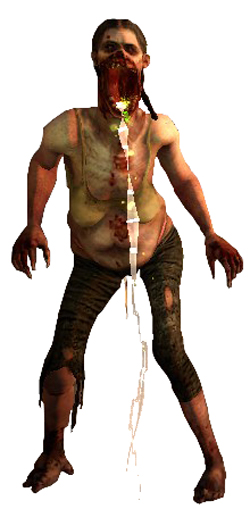
"The Spitter", Infected Bulimic Woman. Left 4 Dead. Image from the Left 4 Dead Wiki.
The INFECTED ZOMBIE,
created by a parasite or rabies-like virus that apparently keeps the body
running long after the brain shuts off, is the more recent, popular kind. Their
sci-fi origin, after all, lends itself to easily-sold, universally-hitting
visceral gore-horror: grotesque mutations and over-the-top symptoms of illness.
Not only that, but while magic now is typically thought passé and silly, you’ll
find people who think that the idea of infection-induced zombification sounds
unnervingly plausible – I encourage you to look up parasites that attack the
brains of ants and slugs. These zombies are also simply termed “INFECTED”, removal of the implications
of the word “zombies” in the terminology providing a fairer term for a subtype
occasionally nicknamed “RAGE ZOMBIES”,
which is the type seen in such films as 28 Days Later – much more alive and spry
than the archetypal shamblers, but every bit as feral, pain-blind, and utterly
incapable of reason. If there’s another draw to use of “infected”, it’s that
their plague-bearing lends to building hordes. For shoot-‘em-up gamers looking
less for a tense horror story and more for new gratifying heads to pop, the
excuse of a zombie plague will give them waves of dozens after dozens of
monsters, however humanlike, to go at without remorse. In the movies,
meanwhile, “In a
World Where” humans risk being outnumbered by the dead, the seed exists for
a distinct plot.
ZOMBIE PLOTS, like zombies, come most clear-cut in two
distinct flavors. Both play on the idea that zombies become exponentially
scarier with numbers – how can you defend yourself against a whole troop of
things capable of thinking about literally nothing but
trying to eat you alive?

The rather displaced Judge and Jury Zombies. Paranorman. Image from IGN.com.
ZOMBIE CURSES and MASS RESURRECTIONS catalyze
old-fashioned dead-rising-from-the-grave stories. They’re not so uncommon in
PG-and-down “scary” media likely because nobody’s life needs to be rushed to an
end, implicitly or explicitly, for zombies to appear. In Tim Burton’s (albeit
not “horror”) Corpse
Bride, most of the people in the Land of the Dead were old – and their
grandkids, widows, and so forth weren’t too displeased to see them once they
realized they only came back to the living world to attend a wedding.

Lee and Glenn going about business. The Walking Dead: The Game. Image from nonspecificaction.com.
Apocalypse media in the meantime has become prevalent enough for its own subgenre within the past
over-a-decade, and, like the rest, the ZOMBIE APOCALYPSE sub-subgenre
is often used by its writers to – often not gently – display their idea of
humanity without organized society. Curiously enough, the zombies themselves
tend to be used to critique that society – filmmaker George Romero is known for
using his zombies as a metaphor for consumerism. There are a few more positive
spins in lighthearted zombie media, which does in fact exist: the silly film Zombieland and
video game Left 4
Dead each focus on a small team of living who stay living by
bonding in crisis. The
Walking Dead, across a graphic novel series, TV show, and video game, seems
to mix it up – its characters survive their best in hard times by cooperating
and aiding each other; it doesn’t mean they’ll do it.

Rick and Glenn, "mingling." The Walking Dead. Image from IGN.com.
Holding to these plots as
those “for” zombies, maintaining formula in their use, and any decision that
improving upon formula necessitates no more or less than more and different
zombies (the latter of which may result in a plot featuring “zombies” that are
not zombies at all – “rage zombies” technically are but pure violently mad living
humans) may be to blame for their dulled relevance and intrigue in popular culture. Naturally,
the more zombies are there, the more ease with which they can get you – or rather,
that you can be “gotten.” There’s little reason to fear TURNING, the ease of which is obligatory to virus zombies, as once
you’re caught and bitten you’ll likely be ripped apart by the ones scuffling
for your meat with the one that did it long before it can begin to fall on you
with a disturbing thump that you’re doomed to turn into a monster; even your
friends and fellow survivors are likely to watch briefly in horror before you
become just another one to the tally. When a fear becomes a part of characters’
everyday life, it ceases to be a fear relevant to the plot more than the fear
of crashing one’s car in reality. Too-pervasive and too-explainable zombies
become little more than another physical threat as is nuclear toxicity or
bandits of zombie-less apocalypse scenarios. Sense of challenge eventually
falls from anything unique to the threat of zombies to survival – most popularly,
in current culture, within cynical terms of social structure and psychology. Zombies’
origin is most compatible with horror; their current use is within thriller, as
much that is labeled “horror” in recent days comes closest to, about what is
happening, and less what is there, or what can happen.
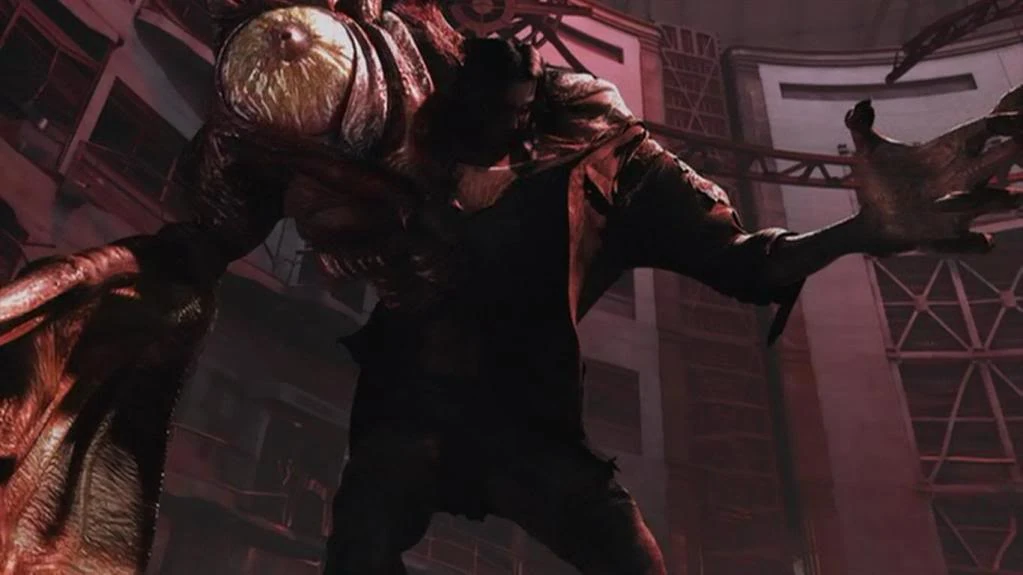
Former Mad Scientist William Birkin. Resident Evil: The Darkside Chronicles. Image from monster.wikia.com.
Conceptual imagination, paranoid
and superstitious or deliberate and daydreaming, is horror’s real spine. All
monsters are products of a degree of imagination, including every form
in which the living dead appear, and a zombie that simply sits about to be a
zombie is indeed rather a heap-of-rot waste. Zombies are nearly always made
from characters or what theoretically would have once been characters, for
example; where does the real fear of being caught by one lie – in the thought
of devouring by something wrong and yet so surely, surely human, or in the
thought of turning and watching everything that you’ve ever considered you
deteriorate in an ultimate of going insane? What are all the implications of the existence of whatever made them?
Monsters eat what they eat within
their stories; on the storyteller’s level, to deprive them of imagination is
to rip out their teeth. They are fully as frightening, creepy as they are not forbidden from being. In all cases, their
minds are their implementers’ – and, therefore, zombies are not mindless at
all.


No comments:
Post a Comment